I like the Shilabe...... Hier kommen Sie zum Test von www.dagogo.com Phillip Holmes: Hier kommen Sie zum Test bei www. 10 Audio .com Miyajima Shilabe Moving Coil Phono
Cartridge Comment from contributing reviewer, Paul Basinski: I've got on a great, but well aged, recording of Harry James and his sweet trumpet sound, and the Shilabe brings him to life beautifully. I just finished playing Sinatra's "September of my Years" on a pristine remaster and it never sounded better. The Miyajima easily sailed through that recording, too. In fact, I was really enjoying the sound of CDs lately on my Cary SLI 80, and yet, with the new cartridge, my LPs clearly sound better. How? In one simple yet crucial way: the Shilabe connects me more with the music. More than the Denon 103R, which is a superb cartridge, but doesn't begin to have the Shilabe's top to bottom articulation of sound. My latest favorite, the Ortofon Bronze is a fun cartridge, but sounds shrill and artificial compared to the Japanese contender. As I've said here before, I am a modest man of moderate means, a college professor who loves to teach political theory and knows how to be tight with a buck. That said, I'm buying the Shilabe. I hope that doesn't mean no turkey for Christmas, Mr. Crachet, but I'll hazard that for a shot at audio bliss. Distributor's Comment: "I must say that I have very little to add! Mr. Seigel covered all the salient points perfectly. My experience has been very similar with many high end MC's. None quite had it "all" - until the Shilabe. One famous arm manufacturer came in my room at RMAF, listened with his own LP's, and bought the Shilabe, and the Premium Mono, on the spot! I actually think the Premium Mono is the "jewel" in the Miyajima-Labs crown. Since installing the Premium Mono I play 50/50 stereo and mono LP's, which is nice as libraries and thrift shops have great mono music usually for a dollar or two! Again, thank you, Jerry." Miyajima Shilabe Moving Coil Phono
Cartridge Let me jump right to the conclusion of this review and save you the wear and tear on your mouse wheel. I have adopted the Miyajima Shilabe stereo moving coil phono cartridge as my long term reference. This decision was reached in precisely 100.3 hours. The Shilabe received 100 hours of break in using the Cardas Test and Burn In LP. Then I listened to one side of one LP. The standing of this cartridge among numerous top-ranked competitors was obvious, and it was a simple decision to leave it installed on my tonearm permanently. Now let me tell you why.
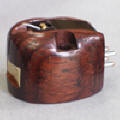
The patent regards the pivot point of the moving coil, which is in the exact center of the coil. This eliminates errors in the conversion of mechanical energy (the moving stylus-cantilever-coil) to electrical energy (the output signal of the cartridge). It took seven years to turn this concept into a product. The result is a cartridge that weighs 10.4 grams, has an output of 0.23mV with a coil resistance of “about 16 Ohms”, and a recommended tracking force of 2.5 – 3.2 grams. The stylus is a Shibata, which has a long contact area and an estimated useful life of 1000 playing hours. The cartridge is low compliance on the order of about 10, but it seems to work well on both TriPlanar VII and Origin Live Conqueror Mk. 3 tonearms. The list price is currently $2,800. Do not be concerned about the relatively high tracking force. It is just a number; your vinyl won’t know the difference. The cartridge body is not threaded, and the bolts have to point up because the nuts will not fit in the recesses in the bottom of the cartridge. I found the 100 Ohm setting on the Manley Steelhead phono preamplifier to give good results. A VTF of 2.9 grams seems ideal, with VTA set to have the rear of the arm just a hair lower than the headshell. The cartridge needs about 10 minutes of play each listening session to "warm up" before it will sound its best. For several months, I have been describing the sound of the Shilabe as a cross between the speed, dynamics and micro-resolution of a Lyra Helikon SL and the warmth and harmonic development of a Koetsu Urushi. The Helikon gets the first 80% of every sound just about perfectly. It has startling speed on the initial attack or impulse. Its ability to retrieve very low level detail consistently reveals new information in well-known recordings. But it glosses over or omits the remaining 20% of each note, offering a sound that is uniformly thin and superficial. The sound is physical, but without much emotion. It is like the stereotypical blond: very good for a while, but lacking depth and long term interest. Shallow. (If you are that blond, I’m sure I did not offend you because you stopped reading after the first paragraph!) The Urushi, on the other hand, offers wonderful warmth and insight into the emotional context of the music. Voices have a very human character and singers are present right there in your room with you. The Koetsu draws you into the performance with an intensity such that it often feels as if time itself is suspended for the duration of the LP. However, while the Urushi communicates emotion and nuance extremely well, it is a bit light on the “boogey factor”. It is warm and rich in the bass and treble, removing some of the excitement and urgency from music that contains a wide dynamic range or extension into the low bass and upper treble. The sound is emotional, with a reduced degree of physical engagement.
The bass performance is exceptional. The bass extension goes very deep and reveals the maximum performance of the outstanding JL Audio Fathom f112 subwoofers. The leading edge impact of a bass drum, for example, will strain both your loudspeakers and amplifier if they are not up to the task of providing large amounts of instantaneous power (amplifier) and woofer cone excursion (speakers). At the same time, the quantity of information in the bass range is revelatory. You easily hear the strings vibrating on an acoustic bass, or the huge power and unique character of a tuba or tympani, or the resounding concussion of a gong. Music flows into the midrange. Percussion, strings, piano, woodwinds, brass – all orchestral instruments – are as true to life as may be possible for an electronic system to offer. Voices, both male and female, have realistic detail and texture which provides the listener a sense that the singers are real, live performers and not a shadow or copy of the original. The upper frequencies are equally excellent. Listen to a soprano, or a trumpet, or cymbals. All demand an evenness of tone, extremely high resolution to not degenerate into white noise, and extension without roll off to enable the instrument to sound coherent and complete. This completeness is a function of quantity, retrieving all of the information present in the LP groove. But it is also dependent on quality, which is the character of sounding real. The Shilabe excels in both requirements of quantity and quality of information to provide very satisfying musical experiences, time and time again. In the song "8th Avenue Shuffle" on the Doobie Brothers LP Takin It To The Streets, the clarity of the tambourine is obvious. This subtle instrument is completely separate and distinct from the cymbals even when the entire band is rocking to the limit. Sting's vocals on "Sister Moon" from his Nothing Like The Sun LP, is wonderfully textured and alive with a startling sense of a real person singing in a small hall setting. The guitar in the same song is forward in the mix and lit with a soft light, but never harsh or discordant. The cymbals, bass, and horns sound perfect, too. A review that does not identify the faults or weaknesses of the component is little more than an advertisement. This review, so far, reads (to me) as over-the-top ad copy. So I’ll offer a little balance and try to maintain my cred as an objective listener and not sound so much like a devoted fan. Here goes. The high frequency performance of the Shilabe is smooth and rich and extended, never going over the edge into brightness or harshness. On its own. Older commercial recordings which are below audiophile quality can sound like exactly that: older commercial recordings which are below audiophile quality. The Shilabe will not transform weeds into roses. BUT, those same recordings may never sound better. So much for fault-finding. One other thing. The oval shape of the African blackwood wood body is wider than some high-end peers. The side of the cartridge just touches the SOTA Reflex Clamp on my SOTA Cosmos IV turntable at the very inside of the LP’s lead-out groove, causing the arm to bounce out a ¼ inch or so. I have not found the clamp to offer a sonic advantage on the vacuum Cosmos, so I do not use it these days. No big deal. The Shilabe is 1mm narrower than the popular Denon D103R phono cartridge. In closing, I would like to leave you with this final thought. The Miyajima Shilabe phono cartridge is closer to perfection than any cartridge I have previously experienced. It may be possible to surpass its outstanding performance, perhaps with a “Shilabe mk. 2”. Until then, I am indeed a devoted fan. If you are searching for an exceptional phono cartridge, you need to hear the Miyajima Shilabe. Overall Rating: 10 LPs I've got on a great, but well aged, recording of Harry James and his sweet trumpet sound, and the Shilabe brings him to life beautifully. I just finished playing Sinatra's "September of my Years" on a pristine remaster and it never sounded better. The Miyajima easily sailed through that recording, too. In fact, I was really enjoying the sound of CDs lately on my Cary SLI 80, and yet, with the new cartridge, my LPs clearly sound better. How? In one simple yet crucial way: the Shilabe connects me more with the music. More than the Denon 103R, which is a superb cartridge, but doesn't begin to have the Shilabe's top to bottom articulation of sound. My latest favorite, the Ortofon Bronze is a fun cartridge, but sounds shrill and artificial compared to the Japanese contender. As I've said here before, I am a modest man of moderate means, a college professor who loves to teach political theory and knows how to be tight with a buck. That said, I'm buying the Shilabe. I hope that doesn't mean no turkey for Christmas, Mr. Crachet, but I'll hazard that for a shot at audio bliss. Distributor's Comment: "I must say that I have very little to add! Mr. Seigel covered all the salient points perfectly. My experience has been very similar with many high end MC's. None quite had it "all" - until the Shilabe. One famous arm manufacturer came in my room at RMAF, listened with his own LP's, and bought the Shilabe, and the Premium Mono, on the spot! I actually think the Premium Mono is the "jewel" in the Miyajima-Labs crown. Since installing the Premium Mono I play 50/50 stereo and mono LP's, which is nice as libraries and thrift shops have great mono music usually for a dollar or two! Again, thank you, Jerry." Link to manufacturer's Web site: Miyajima Laboratory
|

 The Miyajima Shilabe came to my attention for the first time in July of this
year. I was scanning the Analog-cartridges listings on
The Miyajima Shilabe came to my attention for the first time in July of this
year. I was scanning the Analog-cartridges listings on 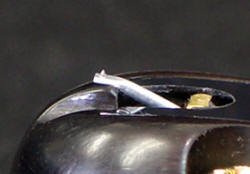 The Shilabe seems to be a perfect marriage of these
two extremes of character. It is warm and rich, but also fast and dynamic. It conveys the
naturalness of the human voice, but also has great bass power and resolution and never
sounds rolled off in the treble. It has even more of the Helikon SL’s speed and
resolution AND provides the harmonic content and interest that is the Urushi’s
enticing quality. I wrote about the
The Shilabe seems to be a perfect marriage of these
two extremes of character. It is warm and rich, but also fast and dynamic. It conveys the
naturalness of the human voice, but also has great bass power and resolution and never
sounds rolled off in the treble. It has even more of the Helikon SL’s speed and
resolution AND provides the harmonic content and interest that is the Urushi’s
enticing quality. I wrote about the